New build vs retrofit solar: why the build phase matters — UK new build solar PV installation
Construction · 7 min read · 14 May 2026

New build vs retrofit solar: why the build phase matters

Installing solar PV during the new-build phase costs 25-35% less than retrofitting the same system to a completed dwelling — and unlocks integration opportunities retrofit can't match.

The most important solar PV decision on a UK new build is when to install — during construction or as a post-completion retrofit. The financial gap between the two is material (25-35% on a like-for-like system), but the more interesting differences are in integration, warranty and aesthetic outcomes.

Cost difference: new build wins by 25-35%

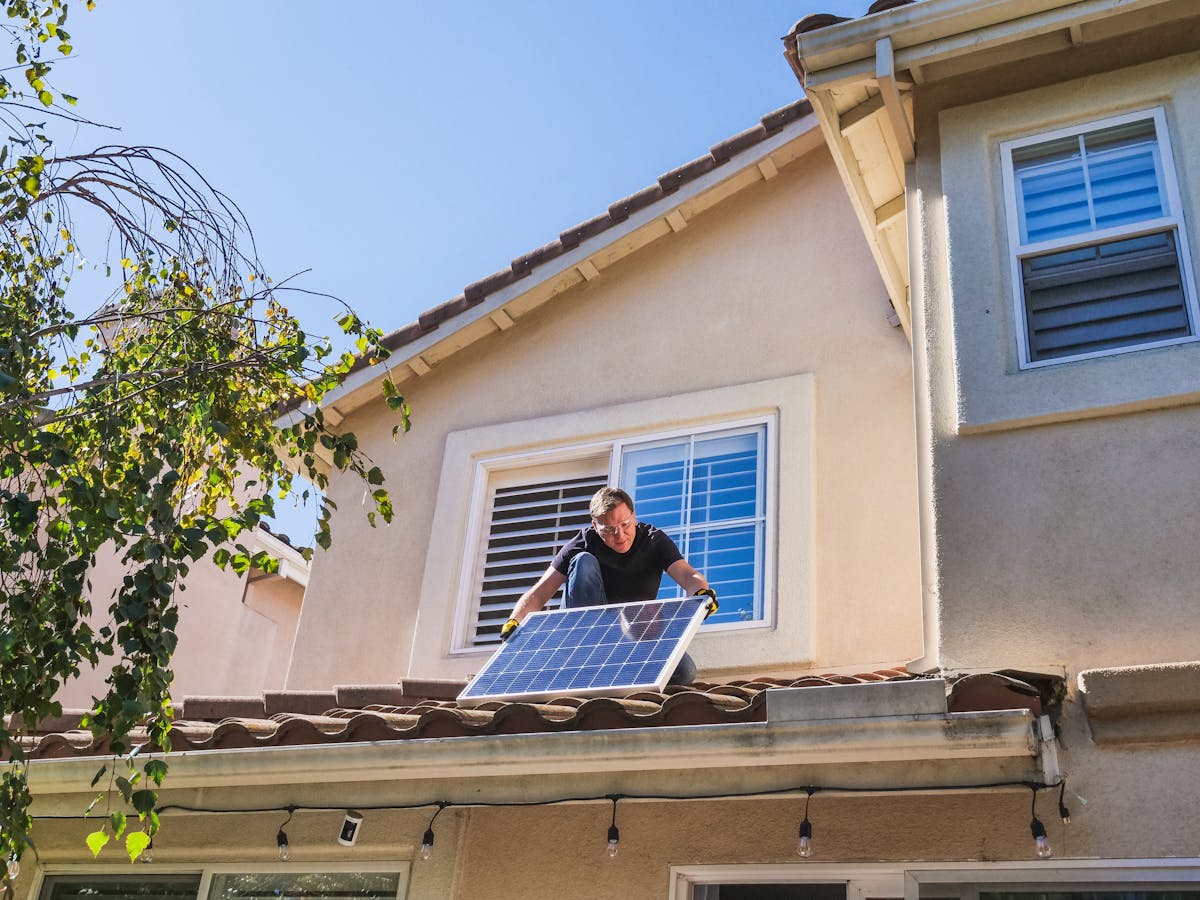
A 4.0 kWp in-roof PV system installed on a 3-bed detached during the new-build construction phase costs approximately £3,950 (volume developer pricing). The same system retrofitted to the completed dwelling 12 months later costs approximately £6,200 — a £2,250 (57%) premium. The cost gap reflects: (1) labour — retrofit requires a separate scaffold mobilisation, additional plot access and 3× the on-site install time vs new-build factory pre-fit; (2) on-roof vs in-roof — retrofit invariably uses on-roof systems (in-roof retrofit requires stripping the existing roof, uneconomic); (3) procurement — new-build installers buy panels through volume frameworks at £0.32/W, retrofit installers pay spot-market rates of £0.42-£0.48/W.

Integration with ASHP, battery and MVHR

New-build installation lets the solar PV system integrate cleanly with the rest of the building services. Inverter and battery locations are planned into the M&E layout at RIBA Stage 3, with adequate clearance, ventilation and serviceability. ASHP and PV controls share a common BEMS where appropriate. MVHR ducting routes around inverter heat dissipation. Retrofit installations work around the existing layout — inverters end up in suboptimal locations (under stairs, behind boiler cupboards), service routing improvised, and post-install commissioning of the integrated control system can take days that would have been hours on a planned new build.

FHS compliance only works at new-build phase

The Future Homes Standard 40% PV requirement applies to new dwellings — there is no equivalent retrofit requirement. Building a new dwelling without FHS-spec PV is not legally compliant from 24 March 2027. Retrofitting to an FHS-non-compliant dwelling is voluntary. This is the underlying reason new-build installation is universal across volume housebuilder programmes from 2027.

Warranty and EPC outcomes differ

New-build installations are typically commissioned with an EPC band A or upper B rating because all building services are FHS-compliant. Retrofit PV onto a 2021-spec dwelling typically lifts EPC from band C/D to band B at best — the fabric and heating system limit the upside. NHBC, LABC, Premier and Buildmark warranties cover new-build PV through the structural warranty programme; retrofit PV requires separate installation warranty (typically 20 years insurance-backed) but doesn't adjust the dwelling's structural warranty terms.

Aesthetic and sales-value outcomes

New-build installations almost always specify in-roof PV — flush with the roof tile or slate line. Retrofit installations almost always specify on-roof — visibly mounted above the tile line on rails. Estate agent feedback from 2025 buyer panels: in-roof installations contribute meaningfully to sale price (4-6% premium on EPC A vs B); on-roof retrofit shows less impact (1-3% premium) because the visible panel array is perceived as added equipment rather than integrated design.

When retrofit is the right choice

Three scenarios where retrofit makes sense despite the cost premium: (1) homeowner buying an existing 2024-vintage non-PV dwelling and seeking to upgrade — retrofit is the only option; (2) developer with existing land bank of pre-FHS plots in build-out — completing to 2021 spec under the transitional period and retrofitting if and when buyer demand justifies; (3) housing association with stock acquired pre-FHS that needs energy upgrades for tenant fuel-poverty intervention — retrofit accelerates outcomes. Outside these cases, new-build phase installation is the clear preference.

The strategic lesson

For any UK new-build project commencing planning from 2026 forward, treat solar PV as an integral building service rather than an optional bolt-on. Engage the PV designer at RIBA Stage 2, lock per-plot pricing at land bid, specify in-roof systems with factory pre-fit on panelised roof cassettes where applicable. The 25-35% cost saving versus retrofit is meaningful, but the integration and warranty advantages are what make the choice obvious.


40% of ground floor area
PV / ground floor area
Mar 2027
FHS in force
75%
CO₂ vs 2013 baseline
£4,350 per dwelling
Per-plot premium
For developers and housebuilders

New build vs retrofit solar: why the build phase matters for volume new-build programmes

Per-plot pricing locked at procurement. Factory pre-fit on panelised roof cassettes. SAP/HEM modelling for every house type included. NHBC, LABC, Premier and Buildmark warranty-accepted workmanship. 20-year insurance-backed system warranty. We work with developers from 50 plots to 5,000+ across multi-site frameworks — agreed pricing, agreed programme, agreed warranty stack.

For self-builders and architects

New build vs retrofit solar: why the build phase matters for one-off custom builds

Engagement from RIBA Stage 2. PV sizing collaborative with the architect. SAP/HEM modelling that gives the architect freedom on glazing ratios and roof geometry. Building Control submission pack ready for the Approved Inspector. 0% VAT on new-build dwellings. Staged invoicing aligned to your self-build mortgage drawdowns. We work with custom-build buyers across England, Wales and Scotland.

How this fits into the FHS compliance pathway

Every FHS-compliant new build must pass three regulatory gates. New build vs retrofit solar: why the build phase matters fits primarily into the second gate — design-stage Part L compliance — but has knock-on implications for Building Control sign-off and post-completion warranty:

  1. 1
    Planning permission Most solar PV on new dwellings is consented within the dwelling\'s primary planning consent. Conservation Areas, Article 4 directions and listed-curtilage plots require additional planning consideration — we handle the planning evidence required for these.
  2. 2
    Building Control — Part L compliance SAP 10.3 or HEM compliance modelling demonstrating Dwelling Emission Rate ≤ Target Emission Rate. PV specification, ASHP capacity, fabric U-values and air permeability all entered into the modelling. We provide the full compliance file ready for the Approved Inspector.
  3. 3
    Post-completion — warranty & EPC MCS certificate, EPC, monitoring app onboarding and 20-year insurance-backed workmanship warranty. NHBC, LABC, Premier and Buildmark all accept our installation specification without query — important if you\'re relying on a structural warranty for buyer mortgageability.

For a fuller walkthrough of the compliance process, see our Part L 2026 page and the FHS PV calculator which sizes a compliant system from your ground floor area in 30 seconds.

Frequently asked

Common questions

Answers to the questions we get most often when discussing new build vs retrofit solar: why the build phase matters with new clients.

When does the Future Homes Standard come into force?
24 March 2027 in England, with a 12-month transitional period running to 24 March 2028 for projects already under construction. The Approved Documents L and F were published on 24 March 2026 (Government statement HCWS1445), giving the industry exactly 12 months of certainty before regulatory commencement. Scotland, Wales and Northern Ireland are following with broadly equivalent regulations on roughly aligned timetables, although devolved nuances apply — Welsh regulations are typically 6 months ahead.
What does FHS-compliant solar PV actually cost per plot?
The Government Impact Assessment puts the total FHS premium at ~£4,350 per dwelling per dwelling (2025 prices, weighted average across heat pump, solar PV, MVHR and enhanced fabric). Of that, solar PV is roughly £4,200 — covering ~3.4 kWp for a typical 3-bed semi (panels, in-roof mounting, inverter, monitoring, MCS certification and 20-year insurance-backed warranty). Larger dwellings cost proportionately more; volume procurement reduces per-plot cost by 20–25%.
Will the 40% PV rule actually be enforced?
Yes — the rule is a functional requirement in the Approved Document, not guidance. Building Control sign-off requires SAP/HEM modelling demonstrating compliance. The previous Part L 2021 token "2-panel" systems no longer pass, since they fall ~85% below the 40% benchmark. The deemed-to-satisfy route requires the full 40%; alternative compliance through enhanced fabric is possible but rarely cost-effective.
Can I exceed FHS minimum specifications?
Yes — and many self-builders and premium developers do. Marginal capital cost of a larger array (e.g. 5 kWp instead of 3.4 kWp on a 3-bed) is only £1,000–£1,200, while the additional generation pays back in 3–4 years at 2026 electricity tariffs. Upgrades that fit easily on top of an FHS-compliant base include battery storage (£3,500–£5,000), larger array size, EV charge point pre-fit (£600) and air permeability below 2 (achievable with deliberate detail).
FHS 2027 deadline approaching

Get an FHS-compliant solar quote in 48 hours

Tell us your plot details — ground floor area, location and target start-on-site date. We return a fully-costed system sized to Part L 2026 (40% PV rule), with the SAP/HEM compliance pack included.